Beyond the Scan: Why ISO/IEC 15415 Verification is Non-Negotiable for UDI
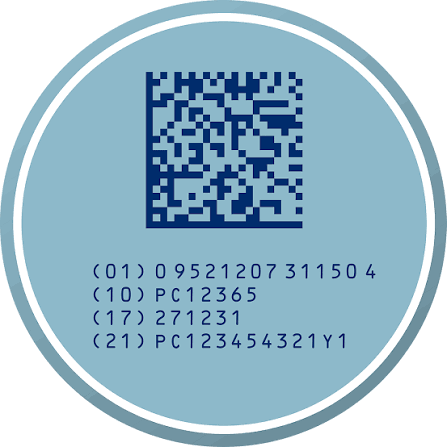
GS1 DataMatrix
In the medical device industry, there is a dangerous misconception: if a barcode scans, it’s compliant. For quality engineers and operations managers, relying on a standard "read" is a high-stakes gamble.
Under FDA 21 CFR Part 801, Unique Device Identification (UDI) mandates require permanent, machine-readable codes—typically GS1 Data Matrix 2D symbols. But a scanner only tells you if a code is readable now. An ISO/IEC 15415 verification tells you if that code will remain readable throughout the device's entire clinical life.
The Gap Between "Reading" and "Verifying"
A standard barcode scanner is designed to be aggressive; it will try to "guess" a code even if the contrast is poor or cells are smudged. Verification is different. It is a formal grading process that quantifies the technical quality of a mark against the ISO/IEC 15415 standard.
To achieve a Grade B or higher, a mark must excel in several critical categories:
Symbol Contrast: The difference in brightness between the dark cells and the light background.
Modulation: Uniformity of the contrast across the entire symbol.
Fixed Pattern Damage: The integrity of the "L" pattern and clocking pattern that tell the scanner how to orient the code.
Axial Non-Uniformity: Ensuring the symbol isn't stretched or distorted.
Why Most Marks Fail the Audit
Standard fiber lasers often produce "glare" or specular reflection on metallic surfaces, which causes machine vision systems to fail. If a single tiny cell (some as small as 0.5mm) is smudged or misplaced, the entire data-rich symbol becomes a non-conformance.
At Laser Flow Labs, we eliminate this risk through a combination of advanced physics and automation:
MOPA Technology: Our 50W HO-MOPA laser offers superior beam quality (M² ≤1.1–1.3) and a tiny spot size (20–40 µm). This allows us to create a uniform "matte" black finish that reduces glare and ensures crisp cell boundaries.
Robotic Repeatability: We achieve near-perfect repeatability of <+/-0.025mm. By removing the "human variable," we ensure the 1,000th part has the exact same focal point and orientation as the first, maintaining consistent grading across the entire lot.
Protect Your Device History Record (DHR)
For a Quality Manager, a failed scan in the field is a nightmare that triggers corrective actions and potential FDA 483 observations. Verification provides the empirical data needed to close out a Device History Record (DHR) with confidence.
As we approach Sunrise 2027, the industry shift toward data-rich 2D symbols means the margin for error has disappeared. Don't settle for a mark that just "scans."
Issue your PO with confidence. Contact Laser Flow Labs today for a feasibility study and a formal AIDC grading report on your stainless steel or titanium components