Marking the "Unmarkable": High-Contrast Delrin Identification with Ink Laser Bonding
For design and quality engineers in medical and industrial manufacturing, white acetal—commonly known as Delrin (POM-H)—is an exceptional material for physical components but a notorious nightmare for permanent identification.
Historically, Delrin has been classified as "unmarkable" when it comes to achieving high contrast. Standard fiber lasers deliver too much heat, causing the polymer to melt or "foam". This leaves a faint, raised, white-on-white mark that is nearly unreadable. Turning up the power only leads to unsightly scorching, charring, or surface ablation that ruins the part's pristine surface finish.
At Laser Flow Labs, we refused to accept "good enough" white-on-white markings. Through intensive development, we dialed in a specialized Ink Laser Bonding process that embeds a dark, permanent, and perfectly flush mark into natural Delrin without surface damage.
The Science Behind Ink Laser Bonding
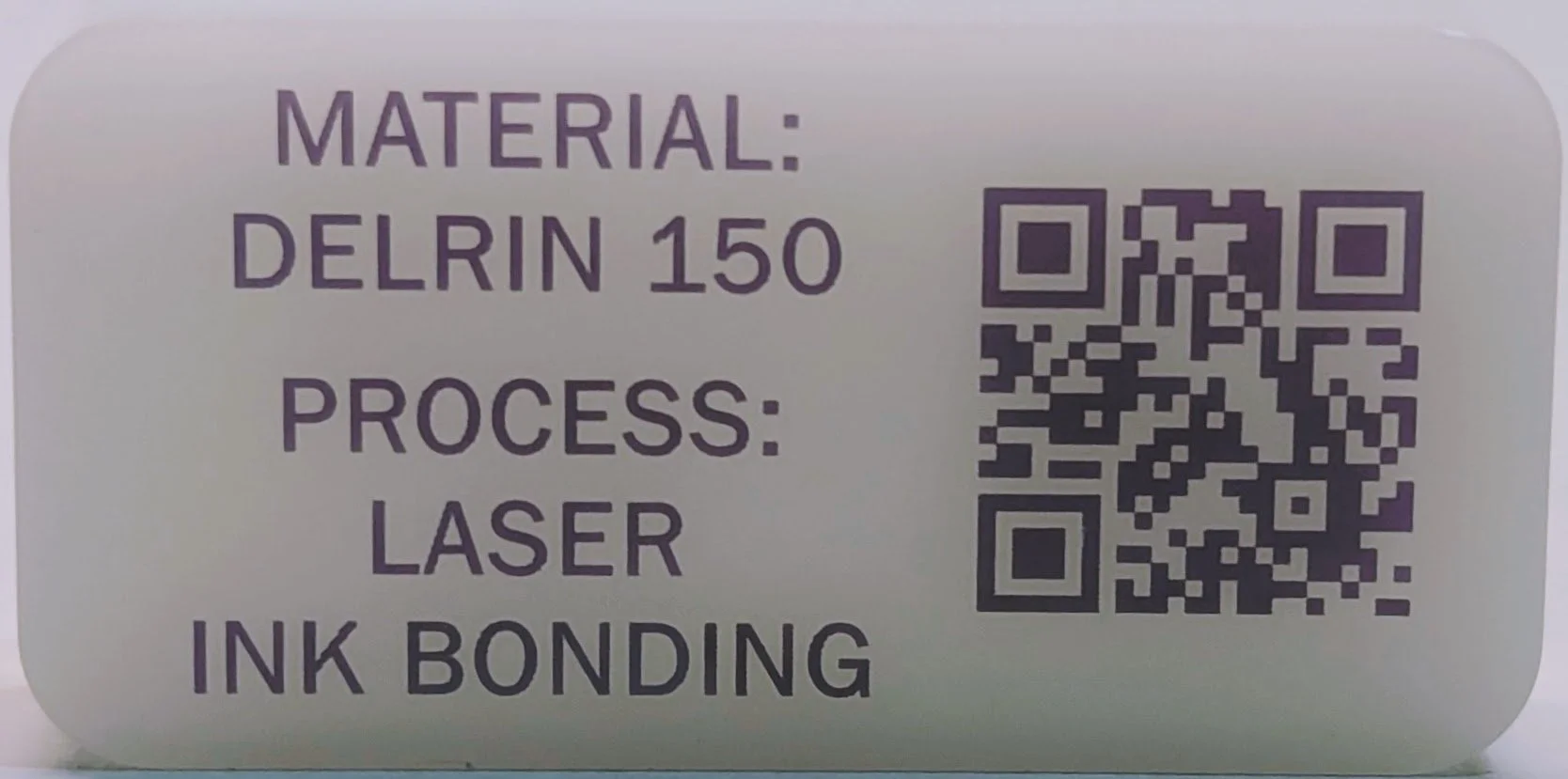
Laser Marked Delrin 150
Our bonding process is not a surface paint; it embeds a dark mark directly into the surface of the Delrin without digging into the material itself. It relies on the perfect synergy of two elements:
Specialized Surface Treatment: We apply a targeted surface treatment to the marking area. This treatment acts as a bonding agent when stimulated by the correct laser energy.
MOPA Laser Pulse Tuning: Standard Q-switched fiber lasers lack the agility needed for delicate plastics. We utilize our 50W HO-MOPA laser system to finely tune pulse durations (down to nanoseconds) and frequencies. This delivers highly concentrated energy in micro-bursts, bonding the treatment into the polymer substrate without overheating the surrounding white plastic.
Once the process is complete, it leaves behind a crisp, dark, permanent mark that remains perfectly flush with the surface.
Why Engineering Teams Choose Laser Flow Labs for POM-H
For medical device manufacturers and precision machine shops, our Ink Laser Bonding process solves critical quality and operational challenges:
Zero Surface Ablation: Because the process does not carve or etch into the plastic, there is zero material removal. The marked area remains flush and smooth, maintaining strict geometric tolerances.
No "Residue Traps": Traditional engraving leaves micro-crevices where bacteria or bio-burden can hide. Our flush, smooth markings preserve the cleanability required for medical-grade applications.
No Scorched Surfaces: By eliminating the high thermal footprint of standard lasers, we prevent the "yellowing" or charring that degrades the cosmetic appeal of white medical components.
Permanence and Contrast: The resulting mark is highly durable and resistant to normal handling, offering a long-term alternative to labels that peel or inks that fade.
Challenge Us with Your Toughest Polymers
If your current marking vendor told you that high-contrast marks on natural Delrin are impossible, they simply don’t have the right technology.
We are so confident in our Ink Laser Bonding process that we offer a free sample marking trial. Send us a scrap component or drawing, and our engineering team will dial in the settings to hit your contrast and readability targets at no cost.
Contact the engineering team at info@laserflowlabs.com or call (612) 446-5488 to discuss your project.