Why Leading Med Tech Firms are Moving to a Specialized Laser Marking Service Bureau
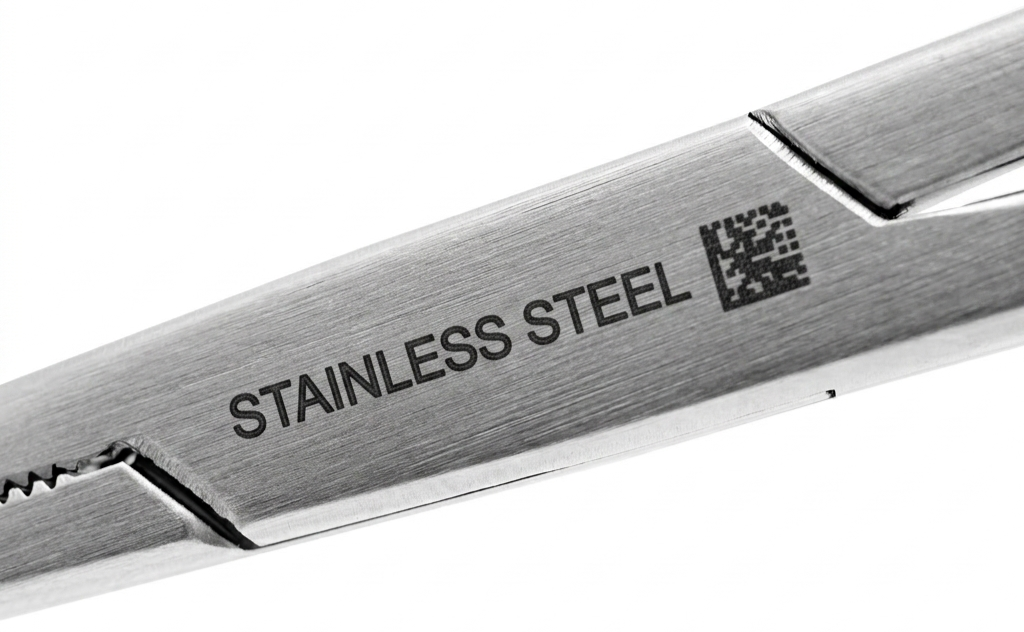
In the medical device industry, the "mark" on a part is never just an aesthetic choice. It is a critical functional requirement, a regulatory necessity for UDI (Unique Device Identification) compliance, and a key factor in the long-term bio compatibility of the instrument.
As manufacturing complexities rise, many OEMs and machine shops are moving away from general-purpose job shops and in-house marking in favor of a specialized Medical Device Laser Marking Service Bureau.
Here is why this shift is happening and how it impacts the lifecycle of a medical product.
1. Beyond the Surface: The Science of Laser Annealing
Most industrial lasers are designed to "engrave"—the process of removing material to create a mark. In the medical world, this is often a failure point. Engraving creates micro-crevices where bio-burden can hide, complicating the sterilization process.
A specialized service bureau focuses on Laser Annealing. By using precise thermal control—specifically with high-output MOPA laser systems—we can induce a localized oxidation layer beneath the surface of 316L Stainless Steel and Titanium. This creates a high-contrast, jet-black mark without breaking the surface of the metal. The result? A mark that is:
Corrosion resistant (Passes citric and nitric acid passivation).
Smooth to the touch (No "nooks or crannies" for bacteria).
Permanent (Withstands repeated autoclave cycles).
2. Navigating the Rigors of UDI Compliance
The FDA’s UDI requirements have turned marking into a data management challenge. It isn't enough to simply "burn a code." The mark must be verified and graded.
A dedicated service bureau doesn’t just mark; they validate. This includes:
AIDC Grading: Ensuring every Data Matrix barcode meets GS1 standards and maintains high readability throughout its service life.
Traceability: Maintaining the integrity of lot codes and serial numbers from the moment the parts arrive to the moment they are shipped back.
3. Specialized Knowledge of Medical-Grade Polymers
Marking PEEK, ABS, and other medical-grade resins requires a nuanced understanding of the Heat Affected Zone (HAZ). Traditional fiber lasers often cause "foaming" or "charring" on plastics, which can compromise the structural integrity of the part or create a textured surface that fails cleanliness standards.
A service bureau utilizes specific pulse-width tuning (MOPA) to achieve high-contrast marks on sensitive polymers with "cold" marking techniques, ensuring the polymer's properties remain unchanged.
4. Operational Efficiency for Machine Shops and OEMs
For many machine shops, laser marking is a "secondary operation" that creates a bottleneck. If the laser is down or the settings aren't dialed in for a specific grade of Titanium, the entire production run stalls.
By partnering with a service bureau like LaserFlow Labs, manufacturers can:
Eliminate Capital Expense: No need to purchase, maintain, and vent expensive laser systems.
Reduce Training Overhead: Marking for medical devices requires a different skill set than traditional industrial engraving.
Accelerate Speed-to-Market: Specialized bureaus are built for fast-turn finishes, ensuring the final step of production doesn't delay the shipment.
Precision is the Point
In a field where "zero-defect" is the baseline, your marking partner should be as rigorous as your machining partner. Moving to a dedicated service bureau ensures that your permanent identification is as well-engineered as the device itself.
Located in Eden Prairie, MN, Laser Flow Labs is a precision laser marking facility purpose-built for the Medical Device and Product Development industries. From UDI-ready annealing on 316L to high-contrast marks on medical polymers, we provide the technical expertise required for today’s regulatory environment.