Passivation-Proof: Validating "Zero-Ablation" Annealing on 304 Stainless Steel
In medical device manufacturing, the "mark" on a device is a critical functional requirement that must survive the harshest environments of its clinical life. At Laser Flow Labs, we recently achieved a significant technical milestone that proves our process is ready for the most demanding regulatory standards: we successfully validated our laser annealing process on 304 stainless steel through aggressive chemical passivation and advanced 3D surface analysis.
The Test: Surviving ASTM A967 Citric 3
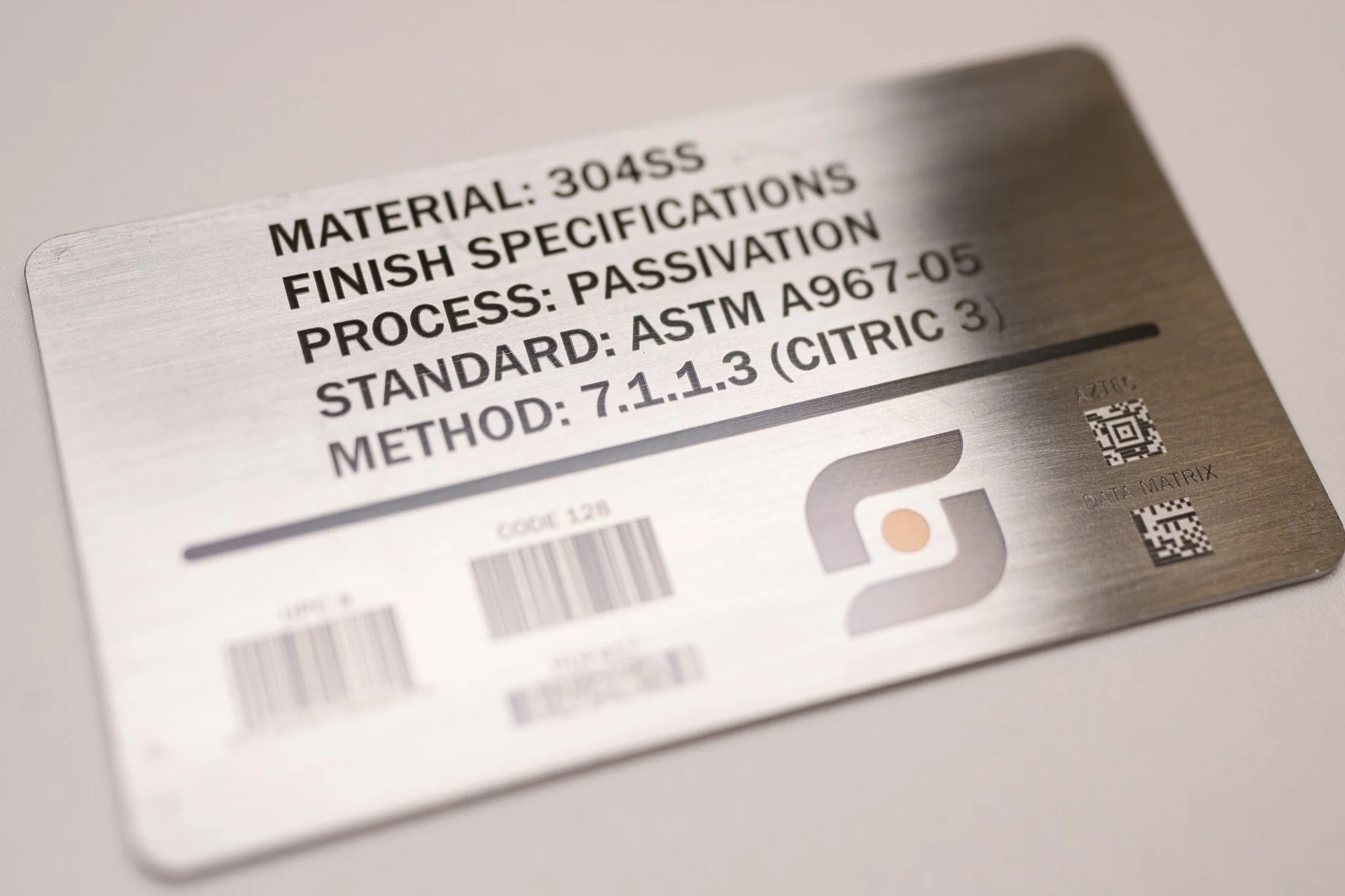
We marked a series of sample 304 stainless steel parts using our specialized annealing process and sent them for formal chemical passivation. We utilized the ASTM A967 Citric 3 (7.1.1.3 Citric 3) method, an aggressive industry standard used to remove free iron and enhance the protective chromium-oxide layer.
The results were flawless: the marks did not corrode, rust, or fade (often referred to as "bleaching"). This success confirms that our system is dialed into the exact energy parameters required to create permanent identification without compromising the material’s chemistry.
Beyond Visuals: 3D Profilometer Validation
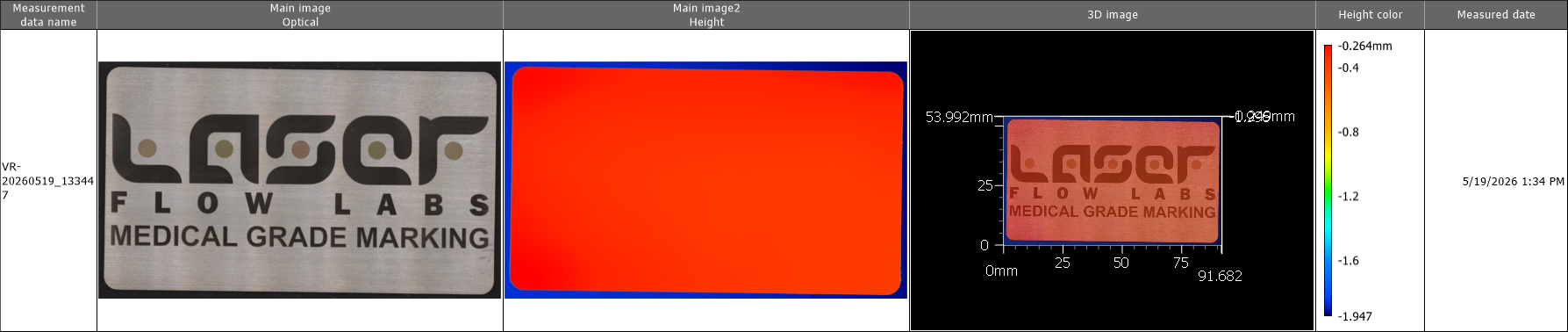
While the lack of fading proved the mark's chemical stability, we went a step further to satisfy the strictest engineering prints that specify "Laser Anneal Only — No material removal allowed".
We further validated the surface integrity by 3D scanning the marked zones with a 3D Profilometer. This analysis confirmed that no material was removed during the process. Unlike standard "etching" or "engraving" that creates microscopic pits where bio-burden can collect, our annealing process keeps the surface flush and smooth.
The Science: MOPA and "Cold Marking"
This level of precision is only possible through our 50W HO-MOPA (High Output-Master Oscillator Power Amplifier) laser technology.
Standard fiber lasers often have fixed pulse durations that deliver too much heat, creating a large Heat Affected Zone (HAZ) that depletes chromium and leads to "halo" rusting. By contrast, our MOPA system allows us to tune the pulse duration (from 2ns to 500ns) to achieve:
True Laser Annealing: We migrate carbon and oxygen to the surface to "grow" a dense, dark oxide layer under the surface.
Precision Energy Control: By using shorter pulses at high frequencies, we achieve "Surgical Black" contrast while preventing the thermal penetration that causes corrosion.
AIDC Integrity: Our marks are verified to Grade B or higher readability for GS1 Data Matrix barcodes under ISO/IEC 15415 standards.
Issue Your PO with Confidence
For Quality and Regulatory Managers, a mark that fades or rusts is a non-conformance that can trigger 483 observations or hold up a Device History Record (DHR). Our successful validation through both Citric 3 passivation and 3D Profilometry proves that your permanent identification will be as well-engineered as the device itself.
Are you looking to de-risk your marking process for a legacy catalog or a new product launch? Contact the engineering team at Laser Flow Labs for a free feasibility study on your 304 or 316L stainless steel samples. We’ll provide the AIDC grading and corrosion-ready marks your quality system requires.