Eliminating the "Human Variable": Why Robotic Repeatability is the Foundation of Audit-Ready Marking
In high-precision manufacturing, especially within the medical device and aerospace sectors, the "mark" on a component is a critical functional requirement. Yet, because laser marking is often the final operation before a device is packaged and shipped, it represents a significant point of risk. Traditional manual marking processes rely heavily on human dexterity, leaving production lines vulnerable to the "human variable"—the slight inconsistencies in part placement, orientation, and focus that can lead to non-conformances.
The High Cost of Manual Inconsistency
Manual marking methods, whether using tapes for masking or hand-loading parts into a laser station, have an inherent tolerance ceiling. If a part slips by even 0.50mm during a manual setup, the resulting mark may be non-compliant with the original engineering print. For Quality Managers, this inconsistency is a "non-starter". A single bad lot can trigger corrective actions, rework costs, and potential 483 observations during an FDA audit.
The Robotic Advantage: Precision at <+/-0.025mm
To eliminate these risks, robotic automation is becoming a prerequisite for medical-grade production runs. By integrating robotic loading and unloading, manufacturers can achieve near-perfect repeatability of <+/-0.025mm.
This level of precision provides several key benefits:
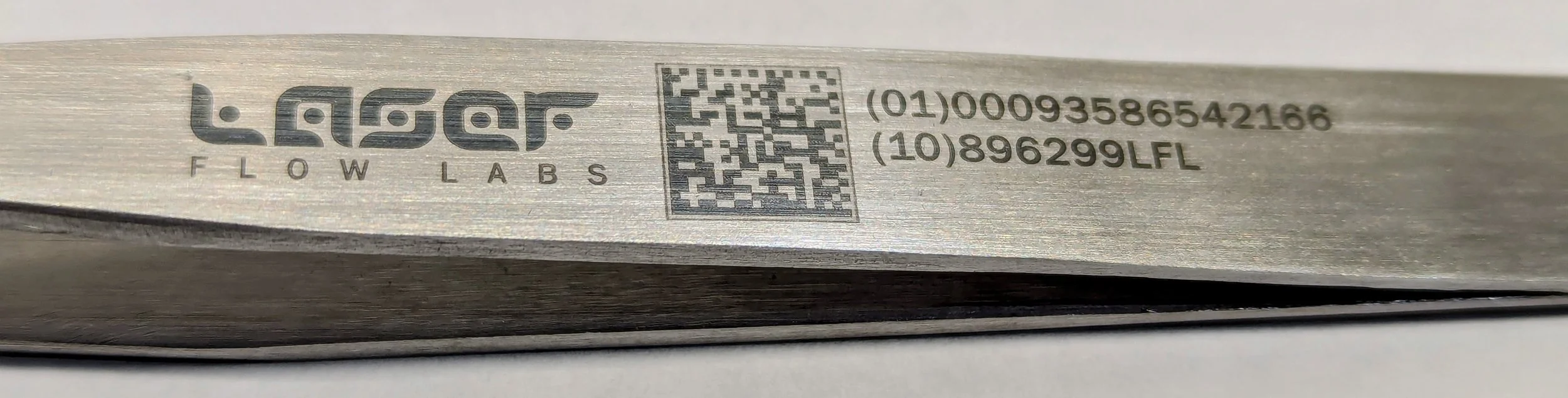
Identical Results, Run After Run: Robotic systems ensure that the 1,000th part is marked exactly like the first article, maintaining the integrity of GS1 Data Matrix barcodes and human-readable text.
Optimized Scan Rates: Machine vision systems require high contrast and perfect cell placement to achieve "Grade B" or higher readability. Robotic consistency eliminates the "glare" or "hot spots" caused by slight variations in part angle during manual loading.
Zero-Ablation Integrity: When paired with MOPA technology, robotic consistency ensures that the laser's nanosecond pulses interact with the substrate at the exact same height and focal point every time. This is critical for achieving a true "Surgical Black" anneal without removing material or creating "residue traps" for bio-burden.
Building an Audit-Ready "Zero-Defect" Baseline
For engineering teams, robotic repeatability is about more than just throughput; it is about process validation. Automated, unattended runs provide a stable, "zero-defect" baseline that simplifies the documentation required for a Device History Record (DHR).
When every part is loaded by a robot, the variables of "human error" are removed from the equation, supporting more robust Installation, Operational, and Performance Qualifications (IQ/OQ/PQ). This reliability allows manufacturers to "issue the PO with confidence," knowing that the final step of production will not hold up their distribution window.
Conclusion: Specialization Over Generalism
While many general-purpose job shops treat laser marking as a secondary "add-on," a specialized service bureau leverages automation as a quality pillar. By moving away from "babysitting" a manual laser and toward a robotic workflow, manufacturers gain the technical authority needed to survive a regulatory audit while accelerating their speed-to-market.
Ready to see robotic repeatability in action? Contact the engineering team at Laser Flow Labs for a video demonstration of our automated cells or to request a First Article Inspection (FAI) on your high-volume production parts.